

We talk a lot about levels in the insurance industry. As an independent insurance agent, you get assigned a level in a hierarchy, and so do field marketing organizations (FMOs), like Ritter!
Insurance carriers play a big part in determining both agent and organizational hierarchies. During your career, you may be at several different levels, even at the same time!
Explore these general definitions and trends so you know where you fit and why!
Insurance Multilevel Marketing
The world of insurance participates in a sales strategy called multilevel marketing (MLM). Different types of insurance agents can participate, too.
We know what you’re thinking, “You mean one of those scams where an acquaintance I haven’t heard from since high school calls me about a ‘getting in on the ground floor of a great business opportunity?’”
We get the concern, but insurance MLM is a legitimate business strategy. The positional hierarchy benefits more from writing business and less from recruiting everyone who’s ever given you their number to join the insurance model business. It’s also different than an illegal pyramid scheme.
With MLM, an insurance carrier example would be direct sales companies, who bring participants into the business to help sell the company’s products and/or services. For every sale made, the participant receives a commission.
Participants can take the form of:
- Contractors
- Independent business owners
- Distributors
- Direct salespeople (meaning insurance agents like you!)
There can be more layers between the participants and the direct sales companies, too, like other participants who recruit more people to join.
Typically, these recruiters will receive a percentage of their recruits’ sales. The recruiters are the uplines, while the recruits are the downlines.
MLM is a legitimate business strategy. The strucutre benefits more from writing business and less from recruiting everyone who’s ever given you their number to join the business.
In the insurance industry, FMOs don’t receive a portion of your commission but they are your upline. Instead, they receive an administrative fee from the carrier called an “override”.
If you’re contracted with an agency (another upline), they will receive an override, too. The override is compensation for training and general agent support services, depending on the level determined in your contract (more below).
Agencies may receive a portion of your commission in return for lead opportunities and marketing support but usually don’t.
General insurance marketing also differs from those less-savory MLMs. Why? Because you’re not required to “buy-in” up front by purchasing stores of product you need to package and resell or risk losing your investment.
In its very definition, MLM embraces hierarchy. How those hierarchies look depends on the industry. In insurance, carriers are the main players in determining who fits where. Of course, it’s not always easy to understand.
Why Do Insurance Carriers Create Hierarchies?
Knowing why hierarchies exist in insurance provides the foundation for understanding how they work. Carriers and FMOs create hierarchies of levels to help define who qualifies as:
- FMOs
- Agencies
- Street-level agents
- Sub-street-level agents
- Licensed only agents (LOAs)
Making these distinctions is important because each of these groups makes different amounts of money in different ways. They must know the level, so that the carrier can pay everyone appropriately.
They must know the level, so that the carrier can pay everyone appropriately.
Insurance companies can also use levels to incentivize agents and insurance agency business models to “climb the ladder” toward more earning potential.
Carriers like when agents and organizations climb the hierarchy because that means more agents are selling their products and profiting. Those agents or agencies with higher levels also take responsibilities off of the carrier like managing and training downlines and providing support and services.
Types of Hierarchies & How They Work
When looking at general trends, we can investigate different types of hierarchies. Both carriers and those at the top of the hierarchy (e.g., FMOs) define level parameters, sometimes in different ways.
Organizational
Within the industry, many kinds of insurance organizations exist:
- FMO
- Independent marketing organization (IMO)
- National marketing office (NMO)
- National marketing alliance (NMA)
- Supervising general agent (SGA)
- Managing general agent (MGA)/brokerage general agency (BGA)
- General agent (GA)
Carriers don’t agree on the exact qualifications between the groups, but they do agree on the general progression from the bottom of the hierarchy to the top. For more information, read our post on FMOs vs. IMOs. vs. NMOs vs. MGAs vs. GAs.
Remember, insurance carriers and certain uplines in the hierarchy, like FMOs, can establish requirements for downlines to maintain their position. These requirements will depend on production or number of downline agents. Carriers and FMOs often choose different numbers.
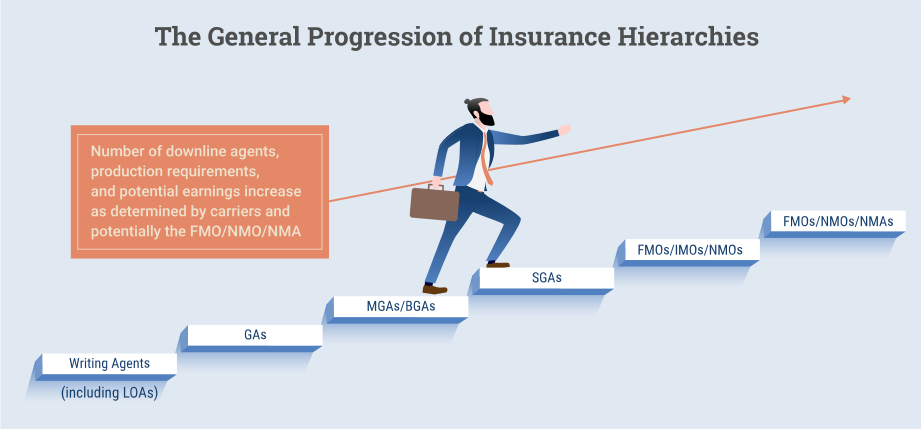
As you can see, although there is some crossover at the top, the hierarchy typically boils down to an FMO at the top and writing agents beneath. Some agency partners (GAs, MGAs, SGAs) may be in between. Being at the top, FMOs must maintain the highest production and downline requirements.
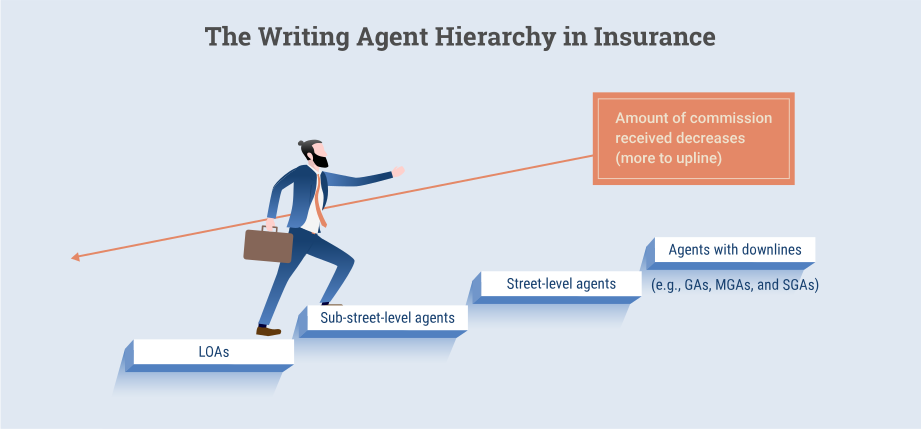
Let’s take the bottom stair writing agents, and expand it further into agent hierarchies.
Insurance carriers and certain uplines in the hierarchy, like FMOs, can establish requirements for downlines to maintain their position.
Writing Agent
Writing agents can be broken down into three main levels:
- Street-level agents
- Sub-street-level agents
- LOAs
The main difference between the three is how each is paid.
Street-Level Agents
Many independent insurance agents are street level. This means they do not have any downlines and receive the industry standard commission when they make a sale.
Depending on the type of contract an agent has with a carrier, they receive payment directly from the carrier or through the FMO (via payment from the carrier).
For Medicare Advantage (MA) plans and prescription drug plans (PDPs), the Centers for Medicare & Medicaid Services (CMS) annually sets this standard for commission or the maximum amount a carrier can pay an agent for a sale.
For Medicare Supplement (Med Supp) plans, there is no federal standard. To stay competitive with each other, carriers keep the commission amount within dollars of other carriers.
Many independent insurance agents are street level. This means they do not have any downlines and receive the industry standard commission when they make a sale.
Sub-Street-Level Agents
When an agent joins an agency, they may sign a contract to become a sub-street-level agent. In exchange for a portion of their earned commission, the agent receives support in the form of:
- Leads
- Marketing resources
- Training
- Access to useful technology
Licensed Only Agents
At the bottom of the hierarchy is the LOA, who assigns all their commission to their immediate upline. How the upline pays the LOA for their work depends on the contract between the LOA and the upline. They might receive a percentage of the commission back or an hourly wage and benefits as a W2 employee.
With an assignment of commissions contract, your upline can keep your renewals if you leave them. Before signing a contract, it’s important to discuss with your upline, what happens to your book of business should you leave their agency.
Being an LOA can make sense for agents who want to “plug and play” into an infrastructure that provides many services. Many LOAs enjoy the predictability of a set hourly wage, schedule, and benefits package.
Here’s how these three types of writing agents look on the hierarchy staircase:
Can Agents Be More Than One Level at the Same Time?
Although levels keep everyone organized in the FMO’s or carrier’s eyes, they can be confusing for agents to navigate because of the lack of consistency. Carrier A may require an agent to have 10 downline agents to qualify as a Level 6, while Carrier B might require 12.
To add to the confusion, carriers measure sales of MA plans and PDPs differently than Med Supps. Even carriers selling both types of products will use a different measuring stick for each:
- MA and PDP contracts will base level eligibility on the number of contracted downline agents.
- Med Supp contracts will base level eligibility on the volume of production over the most recent 12-month period (measured by dollar amount).
Agents and agencies could be one level for one carrier and a different level for another carrier. An agent could be one level for MA plans and a different level for Med Supps, even under the same carrier. That’s not even getting into different product lines like life and final expense! Cue even more levels.
FMOs may establish their own level systems. This could mean taking the most common approaches from carriers and combining them into an attempt at standardization.
FMO levels can streamline the process. They take the focus off all the different carrier levels and put it on the one set of levels established by the organization where you have most or all your contracts.
Level Up with Ritter
Ritter Insurance Marketing is an FMO with an established level system. Just like we make our agents’ lives easier by being an FMO where you can get the contracts you want, we also simplify carrier levels.
We’re here to help you determine where you want to be in that hierarchy and how to get there. Our dedicated agency team assists agents who want to take the step from a street-level agent to an upline with downline agents.
Explore Ritter’s levels and learn more about climbing the hierarchy to form an agency in our free guide, Developing an Agency – Your Guide to Getting Started!

With thel ack of hierarchal standardization, figuring out the particulars of your different carrier levels can get complicated.
Still have questions? We’d love to help you understand the world of levels more, think critically about where you want to land on the hierarchy, and move up the ladder if you’d like! Contact your Ritter Sales team today.
Joining us at Ritter means you don’t have to keep track of as many! We’re a top-of-hierachy FMO for most major national and regional carriers, committed to our agents’ training and growth.




Not affiliated with or endorsed by Medicare or any government agency.
Share Post