
Search engine optimization (SEO) plays a big role in how easily prospects can find your insurance business online.
But how and why is SEO so important? What do you have to do to utilize this helpful tool for your business’ online visibility?
Explore the rest of this post to find out!
Use this navigation table to jump around to different parts of this post:
- What Is SEO?
- How to Grow Your Insurance Business Website
- Technical SEO Tips for Your Insurance Business Website Setup
- Capitalize on External Sites to Supplement Your Site
- Building Lasting Partnerships with Other Local Businesses
What Is SEO?
SEO is the practice of improving your website, so it ranks higher on search engines like Google. Specifically, SEO can help agents like you build sustainable, long-term visibility for your business.
That can position your business in front of highly qualified prospective clients actively searching for coverage.
SEO investment is one of the highest return on investment (ROI) activities for insurance agents. In fact, insurance agents who invest in SEO often see two-to-three times better results than just relying on word of mouth!
How to Boost Local SEO for Insurance Agents
By itself, SEO is a very broad concept to implement within online marketing. Depending on your business’s operating location, you may want to target your SEO to a more localized market.
Local SEO is a series of strategies designed to guarantee your business shows up when prospective clients search for insurance services in the areas you operate in.
Some insurance-specific examples include:
- “Insurance help near me”
- “Insurance help in [city, state]”
Depending on your business’ operating location, you may want to target your SEO to a more localized market.
Nowadays, most clients searching for insurance do so online, using search engines like Google or Bing to find what they’re looking for. Search results are based on reputation, relevance, and proximity to the user’s search query.
How to Grow Your Insurance Business Website
Your website is often the first place prospects interact with your business. When they are searching for insurance agents online, your website is (hopefully!) one of the first things they’ll see.
There are two main areas to focus on when it comes to an insurance agent’s website that we’ll explore below.
How to Optimize Insurance Website Content for SEO
The bread and butter of your site is what you decide to put on it. Tailoring your content to be local is one of the best ways to catch and retain the attention of any prospective clients. That could look like a blog that addresses local insurance trends or community-specific information.
Optimizing Keywords
Instead of directing your keywords broadly, consider targeting location-based and niche search terms to allow you to be found through search engine algorithms. This can look like:
- Product-specific local terms — Phrases like “health insurance in [your city]” or “Medicare Supplement in [your state]”
- Question-based terms — Educational long-tail phrases like “When is the ACA Open Enrollment window in [state]?”
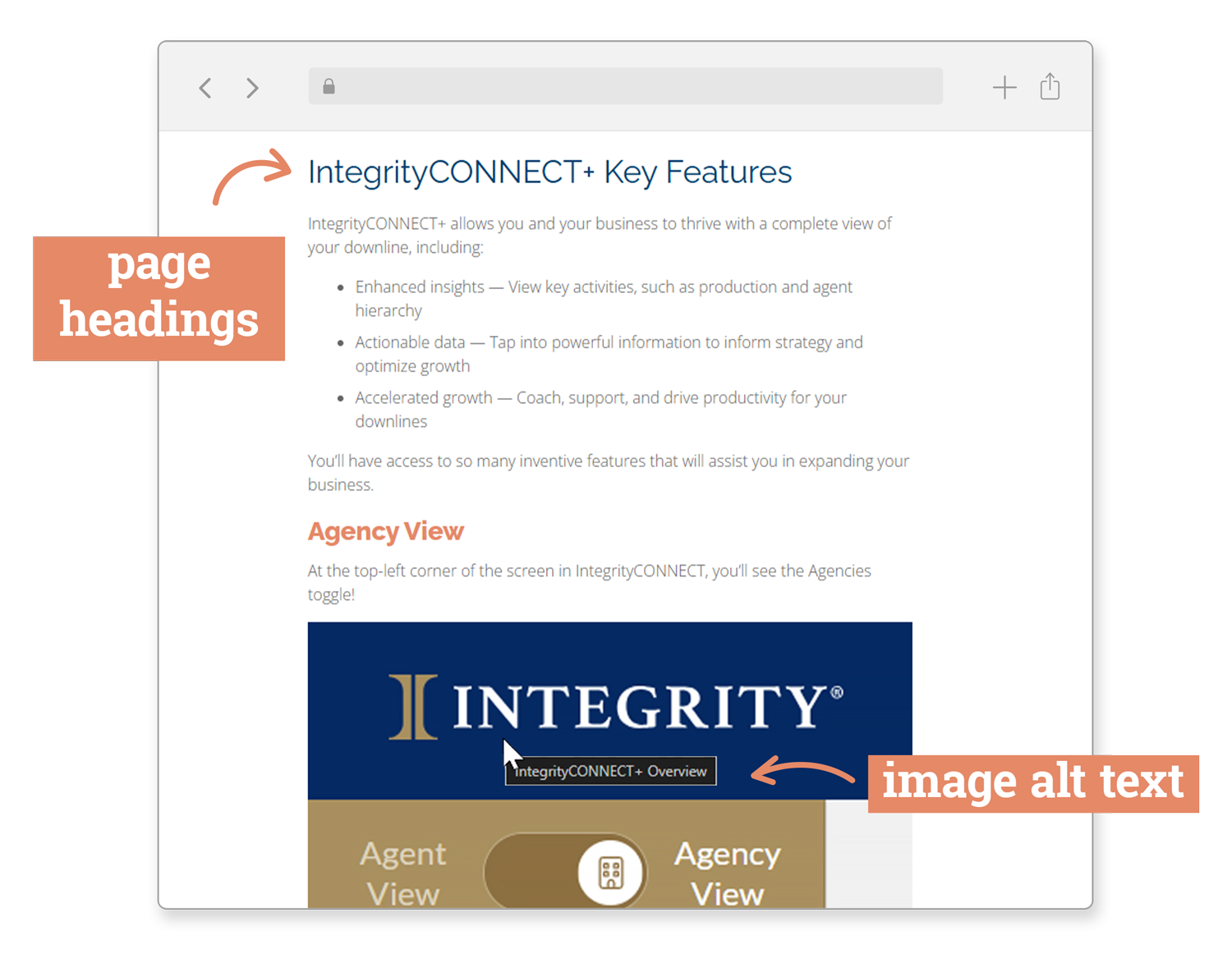
- Implementation throughout your site — Scatter the keywords across meta titles, page headings, and image alt text
Looking for ready-to-use marketing resources? Ritter offers tools and guides designed to help agents improve their online visibility without starting from scratch. Register with Ritter for free and take a peek at our Content Library for more details!
Utilizing External Linking
Having multiple sources to back up what you’re saying on your website can build credibility and trust with any potential clients. You can link to other reputable insurance-related websites, such as:
- Local news outlets
- Industry directories
- Official government-related websites like Medicare.gov
- Any applicable partnerships
Adding these links throughout your site can earn you subtle digital votes of confidence that prospective clients could notice.
In addition, you can also publish highly shareable content, such as interactive calculators or data-heavy state guides, which could also give you opportunities to use links from other sites.
Backlinking
Linking to other sites isn’t the only way to optimize SEO but also to have other sites linking to your website! For example, if you have affinity partners, you could ask them to link your site to their content or on their pages, or link to some of your own blog posts on theirs!
Including Testimonials
Prominently display client reviews and ratings on the front of your website to build immediate trust with new visitors.
However, ensure that you have documented permission from those clients to publicly post any reviews you may solicit from them.
However, ensure that you have documented permission from those clients to publicly post any reviews you may solicit from them.
Real-life success stories and case studies can also prove your expertise and alleviate any anxiety associated with choosing healthcare plans. Adding a page dedicated to that will showcase your abilities as an insurance agent.
Creating Targeted Landing Pages
While the front page of a website is incredibly important for any insurance agents’ business, dedicated landing pages are just as essential for SEO targeting. There are three areas of focus you’ll want to pay attention to:
- Plan-specific pages — Build pages for specific products (e.g., “short-term health insurance” or “Medicare Advantage”)
- Location-specific pages — Create distinct service pages tailored to different cities, states, or neighborhoods to capture localized search traffic
- Focused conversions — Ensure each landing page is designed around a single, specific call-to-action (CTA) (e.g., “Get a Quote” or “Speak to an Agent”)
Ensuring Consistency Across Entire Site
Stable messaging for any brand should build familiarity and ease of navigation for potential or even current clients that visit your site. Some of the ways you can accomplish this include:
- Keeping name, address, and phone Number (NAP) identical across all online directories and social platforms for strong local rankings.
- Maintaining tone, branding, and messaging across websites and social media to build a recognizable, trustworthy local brand.
- Publishing new content and updating existing policies (like during annual enrollment periods) can signal to search engines that the website is accurate and active.
Looking for other ways to spice up your business? Crack open our comprehensive resource, The Insurance Agent’s Guide to Digital Marketing!

Technical SEO Tips for Your Insurance Business Website Setup
As previously mentioned, the physicality of your site should be optimized to further build trust, generate leads, and satisfy search engine algorithms.
Easy Navigation
Avoid clutter on your site as much as you can. That can look like limiting top-level menus to four or five clear options, such as:
- Health Insurance
- Medicare
- About
- Contact
The menu itself can also have a mobile-friendly “hamburger” menu to save screen space.
Organize Headings & Subheadings
Much like how our blog content is organized, you can use logical H1 through H6 tags for your site content. The biggest being H1 and others becoming smaller as you go higher in number. These headings break up dense text for readability and help search engine crawlers understand the hierarchy of your site content.
Submit Your Sitemap to Google for Indexing
A sitemap is essentially a digital roadmap that gives search engines like Google a clear list of all your web pages. These sitemaps speed up crawling and ensure local service pages are indexed. Not only that, but sitemaps being submitted to Google can:
- Allow faster scanning for time-sensitive updates or new insurance products
- Find hidden pages
- Track site health through the Google Search Console
- Protect your content with timestamps
- Improve local SEO by mapping your service area, local office locations, and images
Check out how to create and build a sitemap for Google here
Mobile-Friendly
Given how there is practically a mobile device in everyone’s pocket nowadays, ensuring that your site is easily accessible and navigable on them is key.
Confirm that your site has a responsive design that can automatically adapt to varying screen sizes.
Confirm that your site has responsive design that can automatically adapt to varying screen sizes.
Google, for example, uses mobile-first indexing, meaning that it primarily looks at the mobile version of your site for rankings. Other search engines use very similar indexing as well.
Fast Loading Times
Page speed on your site is critical, especially since over half of mobile site visitors will abandon a site if it takes longer than three seconds to load. The best way to ensure faster speeds is to:
- Compress applicable images
- Use modern formats like WebP
- Use a reliable hosting provider to keep speeds high
Site Security
As you already know, agents handle sensitive, personal information. Obtaining an SSL Certificate to secure your site with HTTPS can do just that, as well as serve as a ranking signal for search engines.
Schema
Implement LocalBusiness and FAQ schema makeup. This type of code feeds search engines specific data, such as:
- Your address
- Business hours
- Answers to common insurance questions
This allows your site to secure “rich snippets” in search results.
If you’re not sure where to start, registered Ritter agents can access resources and support to help optimize your business more efficiently.
Capitalize on External Sites to Supplement Your Site
Your website is only part of your SEO strategy. External platforms can help boost your visibility and credibility all at once!
We’ll go through a few examples that you can use to elevate your insurance business even further.
Google Business Profiles for Insurance Agents
Just about every business has a Google Business Profile, and it’s easy to see why! It essentially puts your business name on the map (quite literally, in fact!) and establishes your business’s digital footprint.
Creating one is also quick, easy, and free!
Once created, you can easily optimize your business profile by doing the following:
- Select the exact insurance categories like “health insurance agency” and “life insurance agency” as primary and secondary tags.
- Detail your exact service area (i.e. counties/cities/states) if you operate a remote or mobile business.
- Add your direct website URL, office hours, and keyword-rich business descriptions that detail your specialties.
- Create regular Google Posts to advertise upcoming enrollment periods (like AEP) or educational workshops.
Facebook Business Pages for Insurance Agents
A large majority of your target audience lives on Facebook, where seniors are the fastest-growing demographic on social media globally.
Not only that, but Facebook exists as a hub where you can build community trust, brand awareness, and social engagement for your business.
To enhance your Facebook Business Page:
- Utilize the Call Now or Book Now buttons to prompt immediate lead generation.
- Share educational content, local community sponsorships, and client testimonials.
- Join and participate in local neighborhood groups to establish local subject matter expertise.
Yelp Business Pages for Insurance Agents
Much like Facebook, Yelp is a great place to foster community in local areas. However, it’s more tailored towards connecting prospective clients in your area with your business.
Because the users are more high-intent and looking for localized, reviewed services, you’ll likely interact more with those looking to actually use your business.
To improve your Yelp Business Page, you can:
- Ensure your NAP matches your website or other applicable external sites.
- Write a detailed About the Business section packed with targeted location and product keywords.
- Monitor and respond professionally to all reviews, both positive and negative, to show active customer service.
Local Directory Listings
While local physical directories have become few and far between, most have translated to the digital realm for the same purposes! These sites now act as foundational trust signals for search engines.
Yellow Pages
Instead of a thick, physical book to put your business in, Yellow Pages has gone digital!
With mobile integration, you can now search for local businesses by typing in a local location or by searching via industry category. Listing your business on the online Yellow Pages is definitely a must!
Business Chamber of Commerce Sites
Joining your local Chamber of Commerce is another great idea that allows you to secure a high-authority backlink to your website. This boosts organic search rankings while also validating your physical presence in the local business community.
Not sure which Chamber of Commerce to link up with? Do a quick Google search on your closest location!
YouTube
Believe it or not, YouTube is incredibly popular with seniors. Approximately 64 percent of seniors put YouTube on top of all other social media, even Facebook!
Knowing that a large portion of your potential customer base is using YouTube, you can use video SEO to establish deeper consumer trust prior to that first initial contact.
Creating a YouTube channel is your first step. Once you’ve accomplished that, you can improve your channel by doing the following:
- Create short-form educational videos that break down complex topics (e.g., “How to choose a Medicare plan in 2026” or “Understanding HSA limits”).
- Optimize video titles, descriptions, and tags with specific local and insurance-based keywords.
- Embed high-performing videos directly onto your website’s landing pages to increase the time visitors spend on your site.
Reviews
Circling back to Google, Facebook, and Yelp, they are also very important for showcasing customer reviews of your business. These reviews generate social proof, remaining the ultimate conversion factor for potential clients.
Google Reviews
Prioritize Google, as these reviews directly impact Map Pack rankings. Automate requests by texting or emailing a direct review link to clients immediately after successful enrollments.
Facebook Reviews
Display these reviews on your Facebook page to offer prospective clients’ public validation of your expertise and customer care.
Yelp Reviews
Proactively manage these to build local trust, as Yelp is a heavily used platform for local service discovery.
Building Lasting Partnerships with Other Local Businesses
Last, but certainly not least, partnerships are a great way to optimize your sites by building reciprocal link networks. These can feature digital partner pages and executing co-branded content marketing.
Partnerships like these can:
- Generate high-quality backlinks
- Improve organic search engine rankings
- Foster trusted referral loops with local businesses and health providers
Resource and Partner Pages
You can create dedicated website directories highlighting trusted local businesses, healthcare providers, and allied professionals.
In return, the partners can feature you on their websites, creating valuable off-page SEO signals and digital citations.
Co-Branded Content
Local clinics or wellness coaches are some great partners to co-author guest blogs, podcasts, or webinars for your site.
Publishing this content on your site can build authority, while the partner promotes the content to their audience to drive referral traffic.
Shared Referral Hubs
Instead of relying just on cold leads, you can create password-protected or public digital referral portals.
Your partners can seamlessly log in or use a form to send a lead, ensuring that partner receives digital recognition or commission while sending traffic directly to your site.
Association Badges
Agents like you could integrate trust signals onto your website headers, footers, or landing pages.
Displaying badges or links for major carrier partners, local Chambers of Commerce, or industry associations validates your credibility to new website visitors.
Optimizing your website for SEO doesn’t have to be confusing or complicated!
Follow our suggestions and your site could be on its way towards more recognition and visibility across a digital-first age of businesses. Start with a few of these strategies and see what works for you and your business!
In addition to helping you improve your business sites, Ritter can also help you with tons of other aspects of your business! From essential resources, tools, and other beneficial guides just like this one, registering with Ritter for free can open new doors to possibilities you only imagined until now.





Not affiliated with or endorsed by Medicare or any government agency.
Share Post