

Closing the sale can be difficult, especially for beginner licensed insurance agents. You want to come across as confident and educated but not pushy like a stereotypical car salesperson.
Knowing how to use effective closing techniques in insurance sales can help you strike the right balance and secure more clients and commissions.
Let’s discuss six specific insurance sales strategies that could help you close the deal.
1. The Modified Puppy Dog Close
Popular among car companies, the classic puppy dog close sales technique allows buyers to test out a product before committing to a full purchase. Think car test drives.
The company Carvana employs the puppy dog close especially well, delivering the vehicle you’re interested in right to your door (or you pick it up) and giving you seven full days and up to 400 miles to decide whether you want to complete the purchase. Talk about a test drive!
What’s with the ‘puppy dog’ name? If you take an adorable puppy home over the weekend to “test it out,” it’s likely you’ll fall in love with it and want to keep it.
While licensed insurance agents can’t offer “test drives” of products the same way car companies can, they can employ a modified version of this closing technique, which gives your client the potential of falling in love.
Your clients do get a test drive of certain Medicare products, namely MA plans. Don’t forget to explain and emphasize the option of the MA trial right to your clients.
If you’re enrolling them in an MA plan during AEP, also don’t forget they could enroll in a different MA plan, or return to Original Medicare, during the MA Open Enrollment Period if they’re unhappy. Just make sure you’re following all the rules for the MA OEP!
2. The Alternative Close
Who doesn’t like to have options? Popular among parents and salespeople alike, with an alternative close, you offer two or more choices.
Each choice could end in a sale or outcome you like. This type of close overlaps with the assumptive close. (Can you spot our assumptive close example that provides the client with choices?)
Be careful with the choice close and avoid belittling your client with meaningless options. No, “do you want to sign with a blue or black pen?” The goal is to empower your client to participate, not give the obvious illusion of choice.
The goal with an alternative close is to empower your client to participate, not give the obvious illusion of choice.
Try these sales closing phrases instead:
- “I think this Medicare Supplement is going to be a good fit. Would it be easier for you to pay the premium as an annual chunk or by month?”
- “It sounds like you’re interested in both this MA and hospital indemnity plan. That’s great! Which application would you like to start with?”
- “I’m hearing that you like different pieces of this MA plan and Medicare Supplement. Do you think you would prefer a lower monthly premium with potentially higher out-of-pocket costs or a higher monthly premium with lower and more predictable out-of-pocket costs?” (After you get your answer, wrap up with an assumptive closing statement.)
As you can see, these alternative close examples offer a range of little to big options. The second example is more about asking a client’s preference for something small (which application to start with). The third example takes more time to consider and is a bigger ask for your client.
If you tend to favor the alternative close within the same appointment, switch back and forth between the big and little choices. That way, your client doesn’t get overwhelmed by a lot of bigger decisions.
3. The Summary Close
The summary close is another technique that pairs well with the assumptive close in sales. In a summary close, you succinctly recap the benefits you’ve discussed and follow up with an assumptive closing statement. You could ask for the sale if you’re confident your client will say yes.
Your client will like the summary close because it demonstrates that you’ve listened to them, identified their needs, and searched for the best fit. Remember, before you jump into the benefits of the plan you’ve pitched, bring up some pain points your client feels. This will make the benefits seem even more relevant.
Your client will like the summary close because it demonstrates that you’ve listened to them, identified their needs, and searched for the best fit.
For example:
- “I know your current MA plan caused you a big headache during your last cross-country trip. This Medicare Supplement is hopefully going to afford you so much more flexibility. You’ll be able to visit any doctor that accepts Medicare and has more predictable costs. We can get started on the underwriting process today! I’ll walk you through it.”
- “Paying out of pocket for your eye exams and new glasses was certainly more expensive than you expected! The dental, vision, and hearing benefits of this MA plan are hopefully going to help with that so much. Let’s get the application started. It will only take about 10 minutes!”
- “You had sticker shock during your last hospital stay. This hospital indemnity plan should help you out and bring those out-of-pocket costs down! Do you have your personal information ready to get started on the application?”
4. The Question Close
Very useful for those clients who aren’t forthcoming with their opinions, the question close allows you to steer the conversation in a variety of different ways. You can ask questions to eliminate objections, clarify responses, or ask point blank whether they want to move forward.
You can ask questions to eliminate objections, clarify responses, or ask point blank whether they want to move forward.
Additionally, consider tossing out a question in response to a question, which throws the ball back into the client’s court. Doing this can provide you with a little breathing room to figure out your response while also empowering your client to articulate what’s important to them.
However, we recommend paying attention to whether your client is receptive of this strategy or frustrated by it; they may view it as an outright deflection or rude.
Here are some ways you can ask questions to close a sale:
- Eliminate objections: “Is there anything preventing you from enrollin in this plan today?”
- Clarify reponses:
- Agent: “Do I understand correctly that having a low premium is important to you?”
- Client: “Yes.”
- Agent: “Great. Do you feel like I’ve understood your needs?
- Client: “Yes.”
- Agent: “Please let me know if those needs ever change. Are you ready to move forward with the enrollment now? We can knock it out in about ten minutes.”
- Question/Question:
- Client: “Does this plan have any added benefits?”
- Agent: “What kind of benefits would you find useful? What would you use it for?”
- Point blank: “Given our discussion, do you see the plan fitting your health needs and lifestyle?”
Remember, a “no” isn’t the end, just a jumping off point for more questions! Although the question close only mentions one in its name, be prepared to ask several or many. You can spread this type of close throughout the meeting to propel it forward toward the final decision.
5. The Benjamin Franklin Close
Sometimes the best way to approach a decision is to make a good, old-fashioned pro and con list just like Benjamin Franklin used to do. The Benjamin Franklin close as an insurance sales strategy works best with either-or decisions, not one that has many options, making the list too complicated.
If you’re at the end of a sales presentation, however, a pro and con list comparing a Medicare Advantage (MA) plan to a Medicare Supplement/Part D drug plan pairing might be just the thing to push your client to finalize their selection.
Writing out the list on a whiteboard or tablet can help your client visualize the options better. This is especially useful for clients having a difficult time deciding what’s important to them.
The Ben Franklin closing technique is especially useful for clients having a difficult time deciding what’s important to them.
You could make a pro/con list showing your client the reasons to buy vs. not to buy from you, but that leaves the door too open for your client to walk away. By comparing two plan options, you assume that your client is going to select a plan (i.e., the assumptive close); you’re just there as an experienced professional, helping them see which plan is the better fit.
Using the Ben Franklin close with the assumptive close to compare two plans can be a win-win. You get the sale either way, and your client might feel empowered and in control of their health decisions.
Here’s an example of a pro and con list comparing two different MA plans:
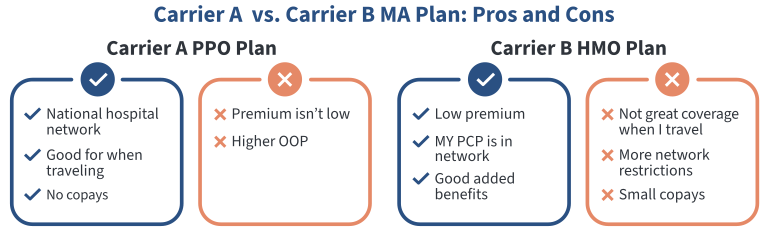
Cross reference the pro/con list to your notes and knowledge of what’s important to your client. Then, wrap this Ben Franklin close with a dash of the question close! “Which plan do you think is the best fit based off our list?”
6. The Modified Sharp Angle Close
Traditionally, the sharp angle close deals with objections by surprising the potential buyer with an agreement statement and then asking for them to sign. For example:
- Person shopping for a car: “I love this car but not those cheap tires.”
- Car salesperson: “If I throw in four free tires, will you purchase this car today?”
The sharp angle is created in your response, by agreeing and asking point blank in the same breath.
As we’ve already mentioned, however, it’s out of a licensed insurance agent’s power to cut deals like this. You can’t reduce premiums. You can’t throw in free XYZ. That’s why you must take a modified approach.
Instead, the modified sharp angle close might look something like this:
- Client: “I”m just not really sure I’d use some of the added benefits that much.“
- Agent: “If I could show you some different ways you could utilize these benefits in a way that makes sense for you, would you be comfortable moving forward with an enrollment today?”
In the above example, the client is stuck on a small detail of the plan. Even though the benefit seems like a no-brainer, people object to things for all sorts of different reasons! Modifying this close takes the objection and turns it into an opportunity for education and exploration.
Modifying the sharp angle close takes the objection and turns it into an opportunity for education and exploration.
If you’re going to make such statements, however, make sure you’re OK with a client potentially saying “No.” But then again, a no could just be another opportunity to try another tactic!
Close to the Close
With seven total insurance sales techniques to use, pretty soon, you’ll be a closing master! You could secure more sales and commissions. Your clients may also trust and understand that you have their best interests at heart. That could mean referrals and increased business!
Want to learn how to improve your closing skills? Register with Ritter and learn from our Sales team. Is there anything preventing you from registering today? It’s completely free, and you gain access to contracts, support, technology, and resources!





Not affiliated with or endorsed by Medicare or any government agency.
Share Post