

Hiring your first insurance agents is one of the most defining decisions you’ll make as a new agency owner. If you’re debating whether to bring on licensed-only agents (LOAs), you’re not alone. Many new uplines wrestle with the same decision.
LOAs can help you jumpstart your growth with experienced, ready-to-sell talent. But they can require more hands-on support, structure, and financial commitment.
We’ll break down the pros and cons of hiring LOAs so you can make the right move for your business model, budget, and long-term goals.
What Is a Licensed-Only Agent?
An LOA is an agent who agrees to give up some of their commissions in exchange for support from an agency. In return, agencies provide leads, office space, marketing resources, and administrative support.
An LOA is an agent who agrees to give up some of their commissions in exchange for support from an agency.
LOAs are a type of captive agent. They have a regular income with a base salary and a stable paycheck. Instead of being captive to one carrier, like other types of agents, LOAs are tied to their agency as a downline agent.
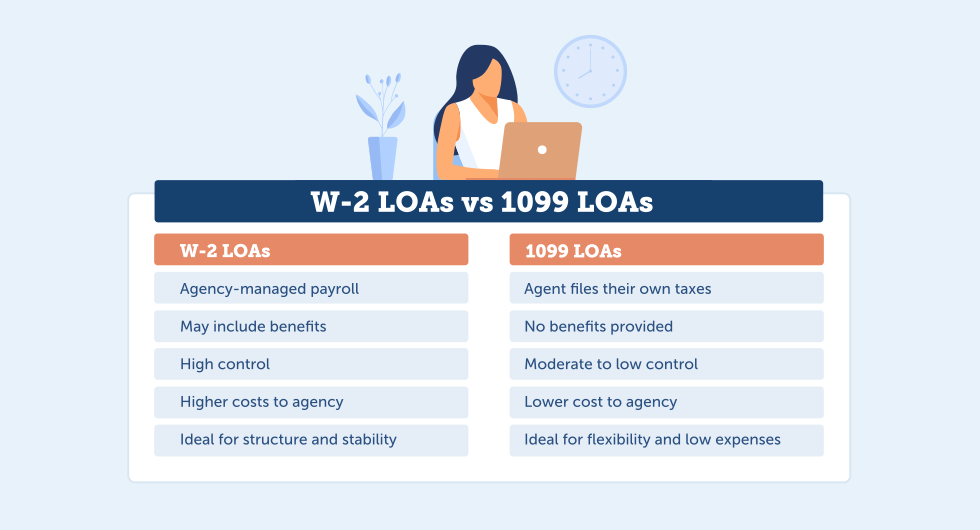
There are two types of LOA models to choose from when creating your business. LOAs can be W2 employees, who might receive a portion of their commission back, an hourly wage, and benefits. The exact compensation package is determined by the agency. Or, they could also be 1099 independent contractors, meaning they pay their own taxes and don’t receive benefits.
Benefits of Hiring Licensed-Only Agents for Insurance Agencies
Let’s discuss the pros of having LOAs when creating your new agency!
LOAs can enrich your insurance agency by increasing its production and generating new growth. Just think, when you have multiple agents signing contracts and meeting with clients, you could accomplish goals you couldn’t reach on your own!
As an agency owner, you’d start building your book of business. Uplines can maintain the book of business after an LOA exits, depending on the LOA contract.
Using LOAs can also provide safety for agency owners because these agents are licensed and familiar with the insurance industry. And because you’re bringing on a team of capable, knowledgeable, and experienced agents, your clients could be more satisfied with the customer service they receive.
All in all, your team of agents will hopefully be more efficient than you could be independently.
Drawbacks of Hiring Licensed-Only Agents for Insurance Agencies
Despite the advantages of forming an agency with LOAs, there are some drawbacks. By restricting the hiring process to LOAs only, you may eliminate individuals that could be good additions to your team.
Additionally, to remain competitive, agencies often have to offer high salaries to LOAs. Lower labor costs are just one reason why many agencies opt to hire 1099 agents.
Operationally, agencies will need to have accounting or commissions software. This software can cost anywhere from $10/month for a basic program to $50/month for more complex software with more capabilities.
You’d also have to have succession plans in place if an agent leaves. If you own the book of business, your agency will still be responsible for servicing the clients that the agent was responsible for.
Are you going to bring on a new agent to replace the one that has left? Or are you going to divvy up the clients among others? These are all important decisions you’d need to make.
Writing a Formal LOA Agreement or Contract
It’s best for agency owners to have a formal, written agreement with LOAs to eliminate confusion and have clear processes outlined. This agreement should outline how your partnership will work.
Start by determining your LOA compensation structure. There are several pay structures you could choose from as an agency owner. Figures listed below are for demonstration purposes only. Decide what’s right for you:
- Base pay plus additional commissions
- Base pay starting at $2,000 to $3,000 a month
- Plus, 75 percent of agent-level commissions on new enrollments
- Commissions only
- 100 percent commissions OR
- 85 to 100 percent of agent-level commissions
- Bonus pay (when compliant, not permitted for Medicare Advantage Prescription Drug sales)
- $250 per every 10 new enrollments in a single calendar month
- Performance incentives
- Tiered incentives for over 25 new enrollments a month
- Renewal commissions
- 50 percent of agent-level renewals
Source: PSM Brokerage
In your contract for LOAs, you’ll also want to define who owns the book of business, and if there’s a vesting schedule. What are the buyout terms if an agent leaves or retires?
Outline specific non-compete policies and consequences if agents are found to violate this policy. Look into your state and federal guidelines surrounding non-competes. These policies can vary from state to state.
You may need to bring on a legal advisor to help you create a contract for your agents. For W2 employees, this agreement can be a part of their employment terms. For 1099 hires, you’ll need to create a separate contract for them to sign.
Additional Planning Essentials for LOAs
You’ve created a contract. What else should you plan for to operate a smooth running and successful agency with LOAs?
We recommend thinking about the full lifecycle of LOA agents and determining:
- Scale, or how many agents you will have in your downline
- Recruitment methods and expenses
- What training you’ll provide (on products, technology, sales, etc.)
- What agent resources you’ll provide (CRM, commission payment/tracking, computers, office space, leads, etc.)
Are your agents going to be using a platform to help them sell? We offer IntegrityCONNECT for free to agents and agencies appointed with Ritter. This is an enrollment tool that agents can use to quote and manage clients in one platform!
When your agents are ready to sell, are they going to be handling appointments on their own right away? Or, will they shadow a more experienced agent for a few appointments before taking the reins? Perhaps you plan on taking on a mentor-type role in your agency. Whatever you determine is best, make sure you practice the same onboarding procedures for all new LOAs.
Overall, an LOA requires more hands-on effort from an upline to ensure success and to encourage client satisfaction.
Overall, an LOA requires more hands-on effort from an upline to ensure success and to encourage client satisfaction. If a client enjoys the service they provide, they’re more likely to stick with the agency, thereby incentivizing downline agents to stay for years to come!
Developing Strong Agents
To encourage your agents to blossom in your agency, think about personal and professional development for your downline. Implement a regular meeting plan, perhaps bi-weekly or monthly, to establish goals and check progress.
Great goals to help your downlines:
- Number of contracts or sales
- Total production
- Year-over-year growth
- Earning a carrier trip or recognition
- Attending specialty events (such as Ritter Summits!)
We also recommend that you implement a strategy so your agents (and maybe even you!) reach out to your clients for reasons other than sales.
Encourage your downline to check in with clients about their coverage, wish them a happy birthday, and celebrate anniversaries. These kinds of communications, without an ask tied to them, build strong client relationships and loyalty.
Final Considerations
Are you prepared to build an insurance agency with LOAs?
Please note that some carriers don’t allow LOAs. This is typically a rare instance, but you should be aware that you may not be able to work with all of the carriers you would like to if you choose this model.
Still unsure if you’re prepared to build a successful insurance agency? Download our free eBook, Developing an Agency Your Guide to Getting Started!

Additionally, continuing education credits are a requirement for health insurance agents, including LOAs. It’ll be up to you to decide if you’re going to compensate your downline for that or establish a way for them to receive their credits.
Really think about the amount of time and support you’re able to offer. Are you busy with your own clients? Or, are you focused on dedicating your time to growing your business and supporting the agents in your downline?
Choosing to hire LOAs for your insurance agency is a great next step to a flourishing business. We hope the tips and questions we’ve posed help you to make decisions for your downline that will lead to success.
If you’re interested in forming an agency with the support of a powerful and helpful FMO like Ritter Insurance Marketing, reach out to our Agency team to discuss your options.





Not affiliated with or endorsed by Medicare or any government agency.
Share Post